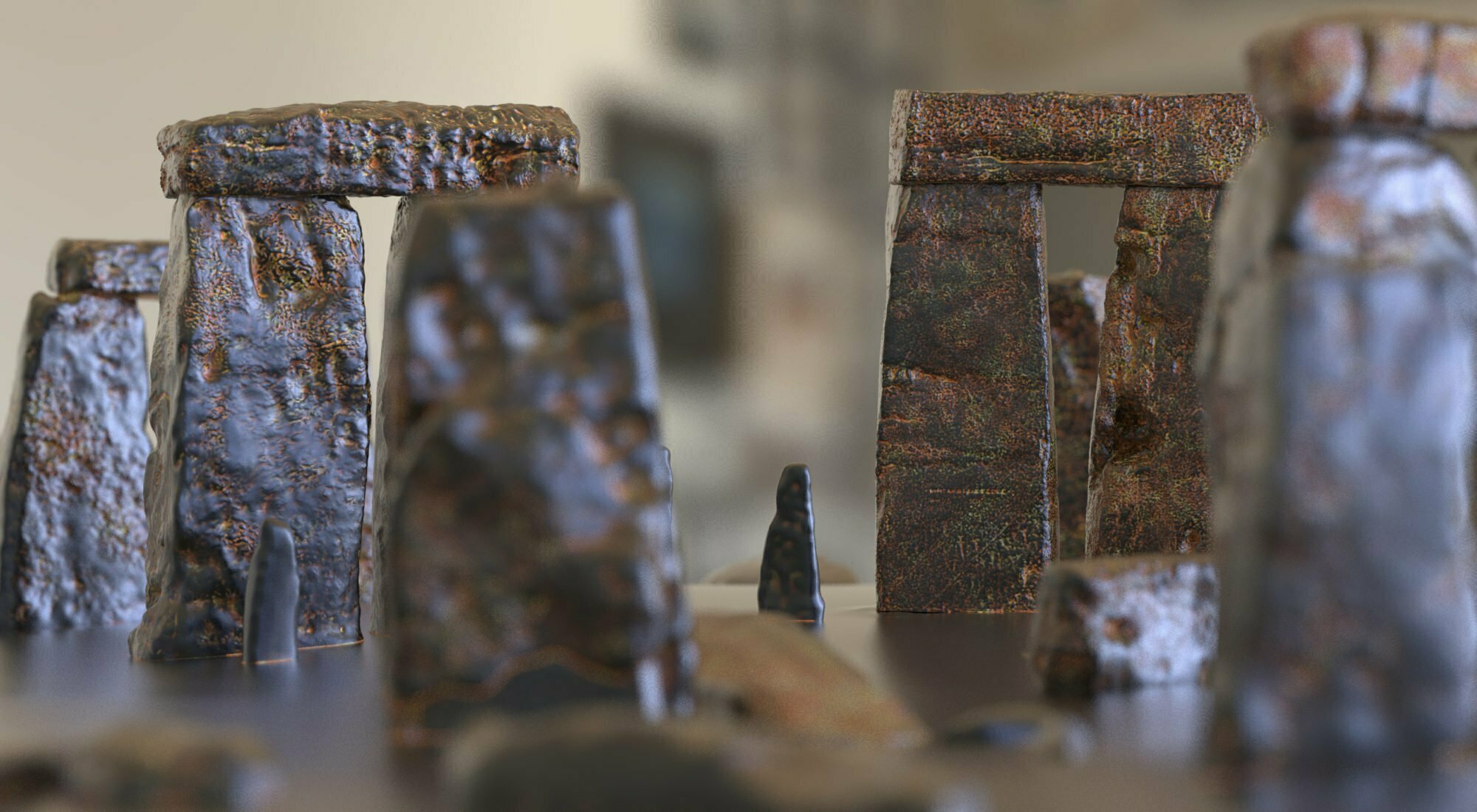
Nobody cut Stonehenge. There was no saw, no chisel, no metal. The sarsens were split, trimmed and then battered smooth with other stones, and the marks of that work are still on them. This page is about the work: what was done, with what, how long it took, and what was left on the ground afterwards. The rock itself is on the sarsen page.
Three jobs
William Gowland, excavating at Stonehenge in 1901, proposed three stages and nobody has improved on the list: splitting, flaking, pecking. Split a boulder down to a rough block. Flake off the worst of the lumps. Then peck the faces flat with hammerstones, hour after hour, until the block is a pillar.
For a century that stayed theory. In 2025 Phil Harding took a 54 kg block of saccharoid sarsen and tried it. Splitting works by direct percussion: repeated blows to the same spot open a crack progressively, unlike flint, which goes all at once, and the half-detached slab acts as its own wedge. Rest the block on a row of stones and strike above them and it snaps square. He scaled a 3 kg sledgehammer on a 20 cm block up to 20 kg mauls on metre-thick sarsen and thought it plausible, perhaps with mauls dropped from a frame. Flaking works, but no flake from Stonehenge or from his block was long enough to cross the mid-line of even the thinnest upright, so flaking shaped nothing; it trimmed. Pecking is the slow part and there is no way round it.
Fire does not help. Aubrey and Stukeley watched Avebury farmers break sarsens with straw fires and cold water, and Gowland and Atkinson assumed the builders did the same. Harding heated his block under charcoal twice: no change in workability, and above about 400 degrees C the surface turns sugary and will not fracture cleanly. Nineteenth-century sarsen cutters split boulders all day without fire. So, probably, did the builders.
The hammers
Gowland sorted the stone tools he dug up into five classes. Flint hammers, hand sized, with battered edges. Rounded sarsen hammerstones about the weight of a bag of sugar. And mauls, up to 29 kg, made of the hard quartzitic sarsen that lies in the coombe gravels around Stonehenge, not the sugary saccharoid sarsen the pillars are made of. Harder rock to hit softer rock. The Marlborough Downs supplied the pillars; the local valleys supplied the tools.
Flint hammers wear out fast. Harding’s lost their edge inside fifteen minutes and one broke in half within the hour, which is why the site is littered with them. Gowland doubted flint could dress sarsen at all. It can. It just needs replacing constantly.
The marks
Look at a sarsen upright under low light and the pecking reads as ridges. Long ones first, running the length of the stone, four to five inches apart, the arrises left standing between strips of grinding. Then finer tooling across them. Then, on the inner faces of the trilithons and the better stones of the circle, a polish that took the ridges off altogether. Stone 59, fallen and broken, shows the first stage with the second never started: the long strips are there, the arrises are proud, and the job stopped.
Image to come: Stone 59, the unfinished longitudinal strips with the arrises left standing, under raking light.
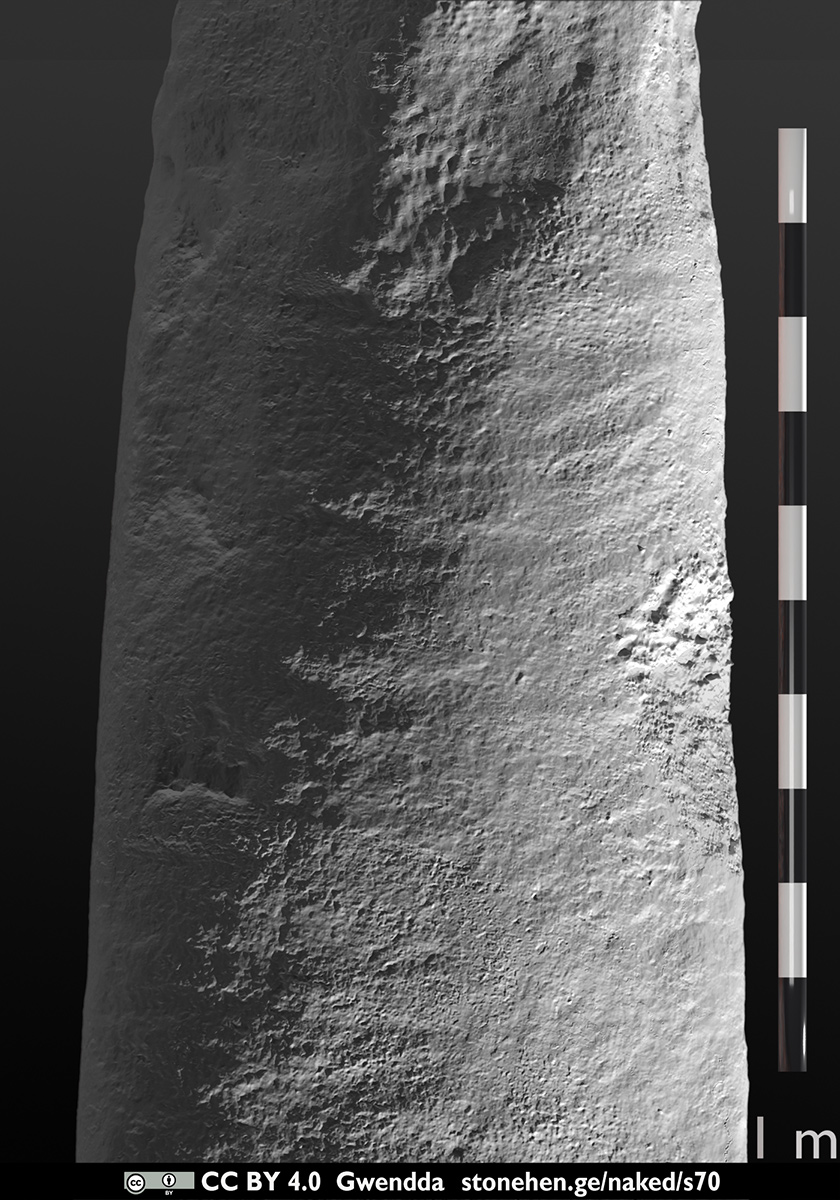
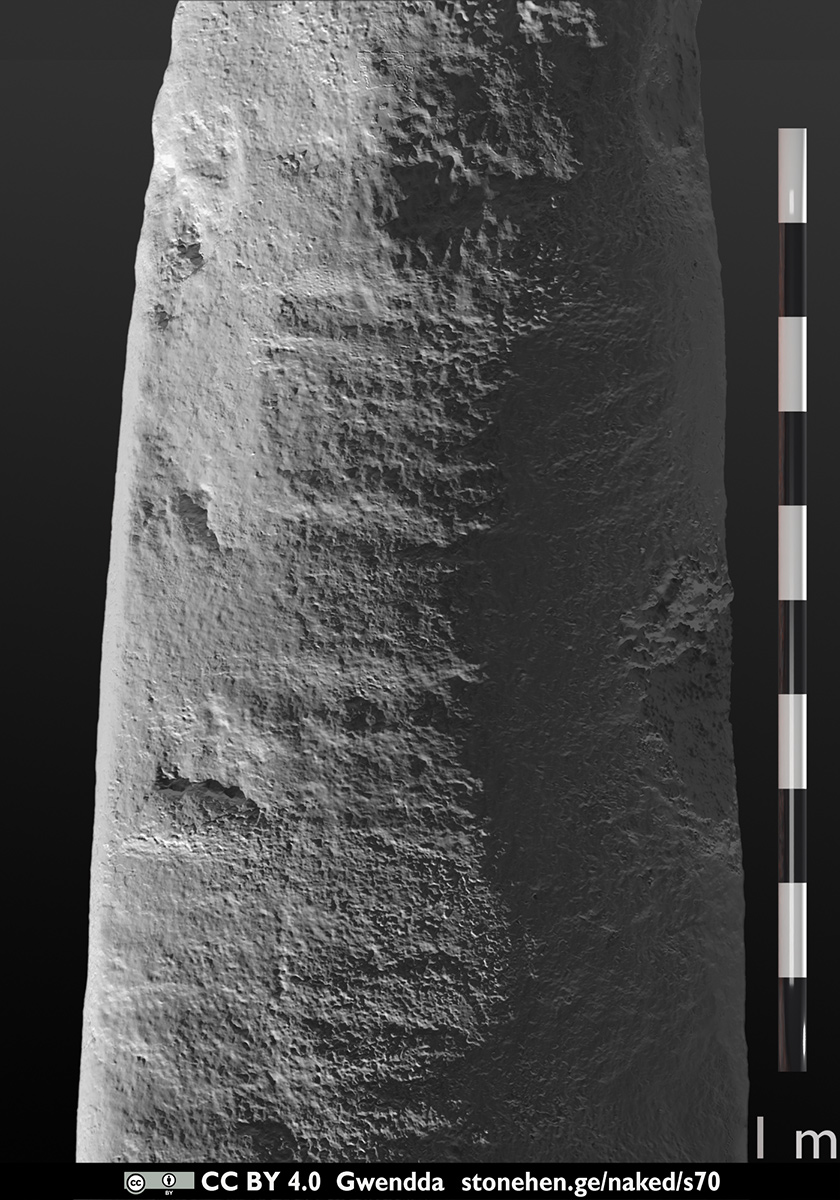
The 2012 laser scan of the whole monument mapped this properly. Inner faces are finer than outer faces. The stones of the circle facing the Avenue and the north-east are dressed more carefully than those round the back. Three stones carry what look like splitting scars, and the outer face of Stone 3 has a large flake scar that dressing never removed. The lintels are dressed on their undersides and edges. None of the tooling is decorative. All of it is finish.
Image to come: Trilithon Two lintel, Stone 154, under raking light, showing the dressed edges.
The renders on this site are made for exactly this. Lichen colour off, raking light on, and the ridges stand up. The Naked Stones plates are the place to look.
How long
Three people have timed it. E. H. Stone in 1924 had a professional mason peck sarsen with a stone maul: six cubic inches of dust an hour. Zaminski in 2020 used 4.5 kg and 2.2 kg mauls and flattened about 0.09 square metres in a day. Harding in 2025, with flint hammers, produced about 16 cubic centimetres of dust every fifteen minutes, roughly a cubic inch, and the rate fell as the surface got flatter.
Take a trilithon upright, one face four metres by one metre, and suppose a centimetre of rock has to come off it to get from split to smooth. That is 40,000 cubic centimetres. At Harding’s rate, about 600 hours. Four faces, one stone: two and a half thousand hours. Fifty dressed sarsens: something over a hundred thousand hours of pecking, before anyone hauled anything. The assumptions are mine, the rate is his, and it is worth saying that a fresh-dug stone might have gone faster (see the sarsen page). The arithmetic is not the point. The point is that the pecking, not the moving, was the job.
The chippings
Dig anywhere near Stonehenge and you find sarsen. Mike Pitts’ trenches beside the old road in 1979 and 1980 gave Hilary Howard 170 kg of saccharoid sarsen and 8 kg of the hard sort. The Stonehenge Riverside Project’s trench north of the monument, published as the sarsen dressing area, held 693 sarsen flakes over 50 mm. But 538 of those were quartzitic, the tool rock, shattered off hammers. Only about 155 were the pillar rock. Inside the monument the sarsen flakes are small, rarely over 20 mm.
In 2024 the chemistry came back. Ciborowski, Nash and colleagues screened 1,028 excavated sarsen fragments and ran full trace-element analysis on 54. None of the 54 matched Stone 58 or the 49 sarsens chemically identical to it. Twenty-two fell into three other families. Fifteen could be traced: eleven to Monkton Down, Totterdown Wood and West Woods on the Marlborough Downs, three to Bramdean in Hampshire, one to Stoney Wish in East Sussex. One Monkton Down flake refits to a removal 26 by 18 cm off the outer skin of a big boulder, so something was dressed on site. Not, on this evidence, one of the fifty.
So the chippings under the turf are real and they are somebody else’s. Hammerstone blanks, small blocks, stones that are no longer there. For the fifty West Woods pillars, the dressing waste has not been found at Stonehenge. Fifty-four fragments from three trenches is not the last word, and pecking waste is dust that falls through the finest sieve and leaves no flakes to find. But Richard Atkinson read the shortage of flakes the same way in 1956, before any chemistry existed: the heavy shaping was done where the stones came from. The final pecking and polish, which leaves only dust, could have been done anywhere.
The bluestones
Most of the bluestones were never dressed. The stones of the outer bluestone circle are boulders and pillars as found. The inner horseshoe is different: the dolerites there, Stones 61 to 72, are shaped pillars, and some carry the same joinery as the sarsens. Several have tenons on top. Stone 68 has a groove down one side and Stone 66 a matching tongue. Stones 36 and 150, now lying in the circle, are bluestone lintels with mortise holes, which means a dressed bluestone setting with lintels stood somewhere before the arrangement we see. Dolerite is as hard as sarsen and takes pecking the same way.
Then there is the rhyolite. Ixer and Bevins matched over 1,200 rhyolite flakes from the Stonehenge debitage to a single rock type, their Rhyolite Group C, and to one outcrop area, Craig Rhos-y-felin in Pembrokeshire. Above ground that rock is represented at Stonehenge by one buried stump, 32d. A thousand flakes and one stump. Either a rhyolite pillar or two was broken up on site, or the flakes arrived as flakes. That is open, and this site does not pretend otherwise. How the bluestones reached Wiltshire is argued on the bluestone page, not here.
Sources. Gowland, W. (1902) Recent excavations at Stonehenge. Archaeologia 58, 37-105. Stone, E. H. (1924) The Stones of Stonehenge. Atkinson, R. J. C. (1956) Stonehenge. Howard, H. (1982) in Pitts, M. W., On the road to Stonehenge. Proceedings of the Prehistoric Society 48, 75-132. Abbott, M. and Anderson-Whymark, H. (2012) Stonehenge Laser Scan: Archaeological Analysis Report, English Heritage Research Report 32. Ixer, R. A. and Bevins, R. E. (2011) Craig Rhos-y-felin, Pont Saeson is the dominant source of the Stonehenge rhyolitic debitage. Archaeology in Wales 50. Chan, B. and Richards, C. (2020) The sarsen dressing area, and Whitaker, K. A. (2020) Sarsen working at Stonehenge, both in Stonehenge for the Ancestors, Part 1. Zaminski, D. (2020). Ciborowski, T. J. R. et al. (2024) Local and exotic sources of sarsen debitage at Stonehenge. Journal of Archaeological Science: Reports. Harding, P. (2025) Demystifying sarsen: breaking the unbreakable. Antiquaries Journal 105, 359-379. Open access.
What I think, and cannot show
Everybody counts the haul. Nobody counts the pecking. A hundred thousand hours with a flint in your fist, for a rock that dulls the flint in a quarter of an hour. That is the monument. The dragging was an afternoon by comparison.
And I keep coming back to the dust. Sand-grade, white, silica. It goes through the finest sieve an archaeologist owns, so it is invisible in the record, and it went into the lungs of the people who made it, so it was not invisible to them. Somewhere under the turf there is a layer of it, wherever they did the last pass. I wonder if it was here. I wonder if it was on the Downs. The flakes say the Downs. The dust would say.