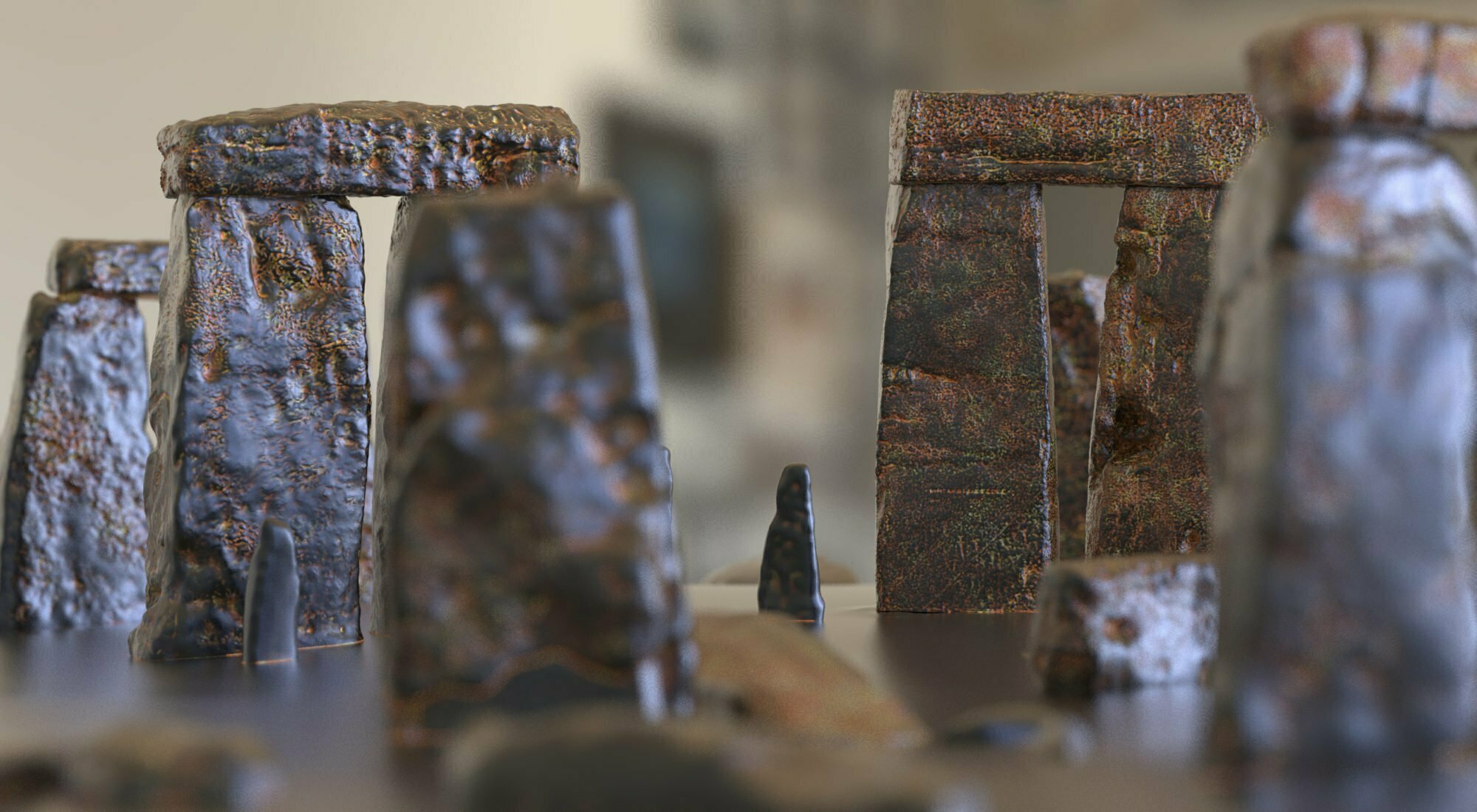
After ~3,530 ya (BC 1,500), nobody moved a stone at Stonehenge for nearly three and a half thousand years. It was never abandoned, never forgotten, never left alone either. People carved on it. Polished it. Worshipped at it. Looted it. Knocked chips off it for healing charms. Then in the 20th century more than three-quarters of the standing sarsens were straightened, re-erected and set in concrete. The Stonehenge you photograph today is, in large part, a 20th-century reconstruction.
« Back to the chronology index | « Read the During page first
Early Bronze Age
The Carvings (~3,780 to 3,530 years ago (BC 1,750 to 1,500), 250 years)
Stonehenge is already close to a thousand years old when it gets its first known decoration. People of the Early Bronze Age, the Wessex Culture with their elite metalwork, carve bronze axe-heads and daggers into the sarsen uprights.
Laser scanning has found 115 axe-head carvings and 3 daggers across the monument, far more than anyone knew. The axes are unhafted flanged bronze types of ~3,780 to 3,530 ya (BC 1,750 to 1,500). The dagger forms match metalwork from Wessex Culture round-barrow burials of the same period.
Image to come: axe and dagger carvings on Stone 53, Trilithon Two. Photographs already on file.
A change in how the monument was used
The carvings sit low on the stones, on the outer faces, at the height of someone standing or sitting beside them. The Neolithic builders organised the monument around the view along the solstitial axis. The Bronze Age people are doing something else: using the stones as a backdrop for personal status, as they did on the stone cists in their own burial chambers.
The monument has gone from collective solar temple to venerated ancestral backdrop. The Wessex elites are claiming Stonehenge for their own dynasties, siting their round barrows to look down on it and cutting their power symbols into it.
Polishing the inner faces
Large areas of grinding and polishing survive on the inner faces of s10 and s53 in particular. The grinding covers the lower two metres and goes with the axe carvings, so it is read as work done after the stones were up, part of the Early Bronze Age smartening of the monument.
A strange picture: people of the Bronze Age, a thousand years after the sarsens went up, rubbing down the inside faces by hand. Worth asking why. Painted afterwards? Made to catch the light? Prepared to throw back ritual fire? We don’t know.
Image to come: polished inner face of Stone 53, close framing. Photographs on file; a naked rake pair when 53 is rendered.
Middle to Late Bronze Age
The Landscape Closes (~3,530 to 2,830 ya (BC 1,500 to 800), 700 years)
The open ritual landscape round Stonehenge closes up. Farming intensifies. The plain is cut into formal field systems, big rectangular fields with bank boundaries, an organised farmed countryside.
Stonehenge stays. It is no longer the focus. Ritual moves to water and wet places: bronze swords, shields and personal objects go into rivers, bogs and lakes across Britain. There is evidence that the Stonehenge Avenue was extended around ~3,030 ya (BC 1,000) to reach the River Avon at Amesbury, a sign that water was now the pull and the old solar monument needed a physical link to it.
A landmark in a busy farmed countryside. Still revered, no longer the working centre of belief.
Iron Age and Roman
Visitors at the Ruins (~2,830 ya (BC 800) to AD 410)
The Iron Age leaves very little at Stonehenge itself. The Druids did not build it, whatever the postcards say; construction had stopped a thousand years before Druids enter the record. Whatever use the monument had in the Iron Age was light enough to leave nothing behind.
The Romans certainly came. Excavation has turned up Roman pottery, coins, brooches and other metalwork in quantities well beyond casual loss. Some archaeologists read it as a Roman reinterpretation of the alignments, a temple of their own in an old shell. They came, made offerings, and went home.
Whatever Stonehenge had been to its builders, it was something different again to the Romans. They still knew it for a holy place. The alignments still worked, the sun still rose where it always had, and they folded it into their own cosmology.
Medieval to Early Modern
Magic and Vandalism (AD 1000 to 1800)
By the medieval period the original purpose is gone. The Saxons call it Stanenges, the hanging stones, possibly for the trilithons, and the name sticks. Geoffrey of Monmouth, writing in the 12th century, has Merlin magic the stones over from Ireland.
Curative amulets
For centuries the stones were held to heal. From at least the medieval period into the 18th century, visitors practised what archaeologists politely call mild iconoclasm: knocking chips off the bluestones to carry as cures or luck. Hammers were sometimes provided on site.
That is the slow, distributed destruction of the bluestone collection. The shortfall in bluestones today is partly how many there ever were, partly Beaker rearrangement, and partly centuries of visitors chipping them away for magic.
The first surveys
In 1666 the antiquarian John Aubrey makes the first systematic survey of the monument and notes the 56 pits that now carry his name. He is the first person in the record to look at Stonehenge with anything like scientific eyes.
The 20th-Century Reconstruction
1901 to 1964, 63 years
By 1900 Stonehenge is a ruin. Many sarsens are down. Some lean badly. s56, the surviving upright of the Great Trilithon, tilts at an angle that looks like it will go.
Image to come: 1919 photograph, outer sarsens propped on timber, general view looking south-west. On file; check the licence before use.
Between 1901 and 1964 a series of restoration campaigns turns the romantic ruin into an orderly design.
- 1901: s56 straightened from a 25-degree lean to vertical, the first major modern intervention
- 1919–1920: Six sarsens straightened and re-erected; foundations consolidated with concrete
- 1958–1959: Three more sarsens re-erected after being lifted with cranes
- 1964: Final major restoration phase: several stones set on concrete plinths
In all, 13 of the 17 standing sarsens in the outer circle were straightened or re-erected. Most were bedded in concrete to keep them there. Mortise-and-tenon joints were kept where possible; some lintels were re-set on uprights that had not carried them in living memory.
The honest implication
The Stonehenge most visitors photograph is a 20th-century architectural reconstruction. It is no closer to its prehistoric state than it was in 1900, and arguably further off, because it has been straightened, regularised and held up by hidden concrete.
Not a complaint. Without the restorations Stonehenge would be a heap of fallen and weathered stone. Worth knowing, though. The clean, photogenic, geometrically pleasing Stonehenge of the postcards is not what the Neolithic builders made. It is what the Edwardians and post-war engineers chose to keep.
Today
Stonehenge passed to the Ministry of Works in 1918, then to English Heritage. In 1986 it was inscribed as a UNESCO World Heritage Site. The visitor centre at Airman’s Corner opened in December 2013, moving the buildings away from the stones.
Around 1.5 million people visit each year. Tens of thousands gather for the summer solstice sunrise, the one ceremony still tied to what the monument was built for, even if the modern neopagan dress would baffle any of the original builders.
The sun still rises through the alignment. Same horizon. Same morning. Five thousand years on.
Population replacement, theological revolution, Roman occupation, medieval superstition, Victorian neglect, 20th-century concrete. The alignment to the sun is the one thing that has never moved.
Return to: The chronology index » | Before the monument | During the 1,500 years of construction