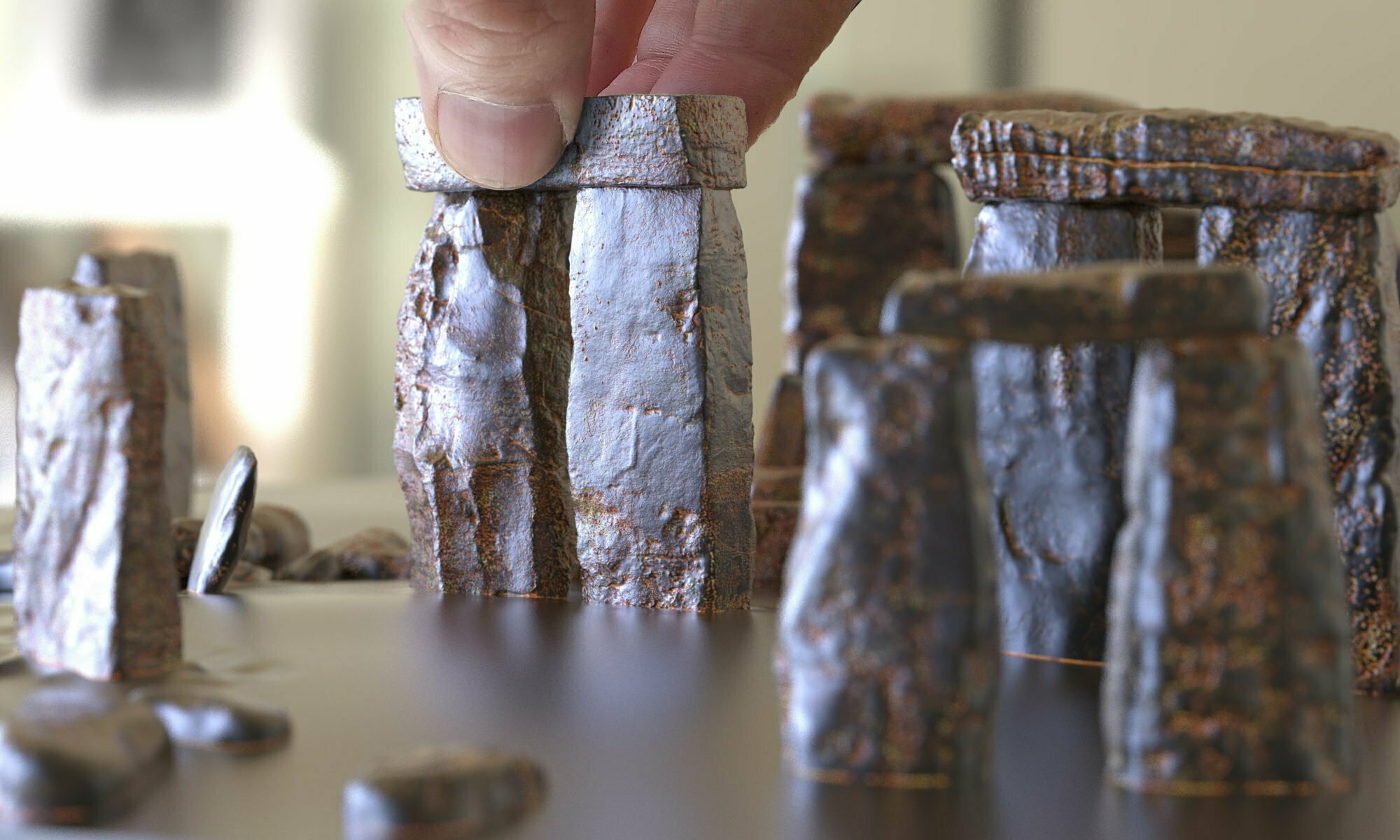
For 1,500 years, from ~5,030 ya (BC 3,000) to ~3,530 ya (BC 1,500), Stonehenge was a building site, a working monument and a cemetery, all at once. Two genetically distinct populations took turns running it. The bluestones were rearranged at least four times. The solstice alignment was never dropped.
« Back to the chronology index | « Read the Before page first
Phase 1
The Earthwork Henge (~5,040 to 4,960 years ago (BC 3,015 to 2,935), 80 years)
The first Stonehenge is not made of stone at all. It is a circular enclosure roughly 100 metres across: a segmented chalk ditch, an inner bank, a smaller outer counterscarp bank. Dug with antler picks. Freshly cut, the bank is brilliant white and can be seen across the plain for miles.
The north-east entrance already sits on the solstice axis. That is the organising idea of the place from day one, and it never goes away.
Image to come: reconstruction of Phase 1. Fresh white chalk bank, the 56 Aubrey Holes, the entrance gap on the north-east solstitial axis, seen from far enough off to show how the chalk carried.
The Aubrey Holes
Inside the bank, 56 pits are cut into the chalk: the Aubrey Holes, named for John Aubrey, who spotted them in 1666. What they held is argued over. The old reading is timber posts. The Stonehenge Riverside Project reads them as sockets for a ring of 56 undressed bluestones, which on the glacial reading were already lying on or near the Plain when the ditch was dug.
The profiles, depths and diameters of the holes match known bluestone sockets from later phases. If that holds, the bluestones were part of Stonehenge from the start, a thousand years before the traditional account puts them there.
Britain’s largest Neolithic cremation cemetery
Stonehenge is a cemetery from the moment it exists. Between 150 and 240 cremated people were placed in and around the Aubrey Holes over the following centuries, the largest Neolithic cremation cemetery in Britain by a distance.
Mostly adult men and women, very few children. A few prestige objects went in with them: a gneiss macehead, ceramic pieces. The pattern reads as the burial ground of one hereditary line, perhaps a ruling family, in business for over seven centuries.
Not a public cemetery. A selected dead, chosen ancestors who went on governing the living from under the turf.
Phase 2
Timber and Rearrangement (~4,930 to 4,630 ya (BC 2,900 to 2,600), 300 years)
Activity picks up. The Phase 1 layout is partly undone: stretches of the enclosure ditch are backfilled with clean white chalk and the bank is cut down. Somebody has changed their mind about something.
A forest of timber
Over 100 post-holes from this period are known inside the henge: rectilinear settings, a central cluster, a passage near the southern entrance. A timber screen sits across the north-east entrance and controls who sees in and who walks through. About 75 metres north-west of the henge a heavy timber palisade goes up, perhaps fencing the monument off from a different ritual ground.
Wood for the living, stone for the dead, playing out on the ground. Temporary timber for the rituals of the living. Permanent stone to hold the dead.
The bluestones rearranged
If the bluestones stood in the Aubrey Holes, they are now shifted into a double arc inside the henge, the Q and R Holes. The setting is never finished; the holes are backfilled before the plan is complete. Something interrupts it.
The 43 surviving bluestones and the debitage around them run to about 30 rock types: spotted and unspotted dolerite, dacites, rhyolites, micaceous sandstone, calcareous sandstone, tuffs. That spread is the glacial case in one sentence. Ice scours a wide range of geology and drops it in a heap; people pick out the striking pieces. It is a case, not a proof.
Pilgrims from afar
Strontium and oxygen isotopes from some of the buried show people from western Britain, Brittany and possibly the Alps. Stonehenge is already pulling visitors from across the sea.
The Orkney connection
Britain was not a string of isolated villages. Grooved Ware pottery, first made in Orkney, becomes the main ceramic at Stonehenge and at Durrington Walls 3 km away. The same rosette motifs turn up on pots at both ends of the island. A shared cosmology, possibly shared ritual specialists on the road between the two.
Durrington Walls, home of the living
Three kilometres from Stonehenge, Durrington Walls grows into a timber henge and settlement of perhaps hundreds of houses. Pig bones from the feasting middens include animals walked from as far as Scotland for midwinter feasts. This is the domain of the living, timber and noise, the residential half of the pair with the stone monument 3 km to the south.
Image to come: aerial reconstruction or map. Stonehenge, Durrington Walls, the River Avon and the Avenue between them.
Phase 3
The Great Sarsen Construction (~4,650 to 4,510 ya (BC 2,620 to 2,480), 140 years)
This is when Stonehenge becomes the Stonehenge you recognise.
Seventy-five to eighty sarsens, a hard silicified sandstone, are brought to the site. Where from is less settled than the headlines say. West Woods, south of Marlborough and about 15 miles (25 km) north, is the closest current match (Nash and colleagues, 2020), but only six candidate sites were sampled, and sarsen drifts nearer the Plain may simply have been used up, leaving nothing to test against. Brian John has the argument, and a note on the colour clusters I pointed out among the stones. We will get to it here one day. The largest, s56, the surviving upright of the Great Trilithon, stands over 9 metres long and weighs an estimated 50 tonnes. Whatever the distance, this is human haulage at industrial scale.
Image to come: Stonehenge today, sarsen circle and trilithons, ideally with a 1:200 diorama print in shot for scale.
Engineering in stone
The sarsen phase is the most sophisticated prehistoric architecture in northern Europe. The stones are not just stood up. They are joined:
- Mortise and tenon joints: the uprights have raised tenons that fit into matching mortise hollows on the lintels
- Tongue-and-groove joints: lock the lintels together side-to-side, forming a continuous ring
- Graduated height: the five trilithons form a horseshoe that rises toward the central Great Trilithon
- Trapezoidal shaping: the uprights are wider at the top than the bottom, creating a deliberate optical illusion of greater height when viewed from below
Carpentry in stone. The builders had generations of timber work behind them and took it into a material they expected to outlast them.
Image to come: mortise hole on a fallen lintel, or a diagram of the mortise and tenon joint. A render from a lintel mesh would do.
The Avenue and the solstitial axis
The north-east entrance is widened by backfilling the eastern ditch terminal and taking out part of the bank. The new opening sits on the midsummer sunrise looking out and the midwinter sunset looking in. Not roughly. The accuracy is built into the geometry.
The Avenue is built: parallel banks and ditches running 3 km from Stonehenge to the River Avon, laid along the natural periglacial stripes that happen to point at the solstice. A processional route from the domain of the dead, in stone, to the water, and up the river to the timber settlement at Durrington Walls.
The Altar Stone
The Altar Stone, a six-tonne block of micaceous sandstone, lies at the focus of this axis. Where it came from is the liveliest argument in Stonehenge geology. The 2024 result put its source north of the Iapetus Suture, in old Laurentian Scotland, and that much holds. The Orcadian Basin and Caithness attributions that followed do not: Orkney itself has since been sampled in the field and ruled out, and the Caithness comparison rests on a small set that included two shop-bought samples. My own preferred answer is a lost or submerged Old Red Sandstone bed in the wider Firth of Clyde region, carried south by the Irish Sea Ice Stream, and it is a hypothesis, not a finding. The Altar Stone pages set out the evidence, the sampling problem, both transport cases and where I stand.
Whatever it is and wherever it came from, the Altar Stone lies at the focus of the whole monument. Whatever the sarsen builders were honouring, this stone stood at the heart of it.
Thirty million hours
Estimates put Phase 3 at over 30 million hours of labour. Moving the sarsens. Dressing them. Raising them. Building the Avenue. Feeding everyone. That needs a central authority able to raise and feed thousands of workers over several generations. Someone, or some institution, ran an enormous multigenerational project. The levelling of the Early Neolithic is coming apart.
The Population Replacement
The Hinge of Everything (~4,530 to 4,030 ya (BC 2,500 to 2,000), 500 years)
The most dramatic and least talked about event in British prehistory.
From around ~4,530 ya (BC 2,500) a new population reaches Britain: the Bell Beaker people, carrying steppe ancestry from the Eurasian grasslands and arriving by way of the Lower Rhine. Within roughly 500 years, more than 90% of Britain’s Neolithic gene pool is replaced.
Ninety per cent. The people who designed and built the sarsen phase are, within perhaps ten generations, almost wholly replaced by a genetically distinct population.
A visibly different people
- Skull shape: Neolithic Britons were long-headed (dolichocephalic). Beaker people were rounder-headed (brachycephalic). The change is visible to the naked eye.
- Height: Beaker people were 5–6 cm taller on average. No evidence of dietary shift to account for this: it is genetic.
- Material culture: distinctive beaker pottery, copper daggers, gold ornaments, archery equipment.
Was it violent?
Probably not an invasion, but the outcome is the same. Around Stonehenge the evidence points to hundreds of years of coexistence. Newcomers and locals lived side by side, swapping ideas and borrowing each other’s kit. The genetic outcome is still near-total replacement.
How is not fully understood. Gradual displacement, differential fertility, disease, intermittent conflict, or all four. The two populations could and did intermarry. Over ten or twelve generations, the older British gene pool all but vanished.
The Amesbury Archer
The best known individual of the transition is the Amesbury Archer, buried around ~4,430 ya (BC 2,400) in the Stonehenge landscape. Isotopes say he grew up on the Continent, possibly the Alps. He arrived as one of Britain’s first metalworkers. His grave held copper daggers, gold hair ornaments, a full archery kit and Beaker pottery: the complete warrior-elite outfit.
The Stonehenge Archer
A young man buried in the Stonehenge ditch itself, killed by arrows in the same period. Isotopes say he was local. He was buried with a Beaker toolkit. The old population was taking on the new culture and its warrior ideology, sometimes while on the wrong end of it.
The theology of the individual
The deepest shift in the whole chronology. The collective ancestral religion that built Stonehenge falls apart. Communal cremation ends. Long barrows are abandoned. Single burial under a round barrow becomes the norm: one grave, one body, personal goods, weapons, gold. Over the next few centuries the Stonehenge landscape fills with hundreds of them.
A different answer to the question of what a person is. From dissolving into the ancestors, to being raised up alone in death. The new people are not only genetically distinct. They hold an incompatible cosmology.
Phases 4 & 5
The Beaker Modifications (~4,310 to 3,960 ya (BC 2,280 to 1,930), 350 years)
Stonehenge is now run by people who did not build it. They inherit a monument whose architects are genetically gone. They modify it carefully, perhaps without fully understanding what their predecessors meant, and they keep the solstice alignment without question.
The final bluestone arrangement
The bluestones, some of which had probably stood in the Aubrey Holes a millennium earlier, are moved again, into two new settings:
- The Bluestone Circle: approximately 70 bluestones arranged in an outer circle between the sarsen circle and the trilithons
- The Bluestone Horseshoe: within the sarsen horseshoe, the bluestones are first arranged in an oval of 23 stones, then four north-east stones are removed to create a horseshoe mirroring the great sarsens
The inner bluestone horseshoe is dressed with fine transverse tooling, far more careful than the sarsens got. The new people are showing off. Not just keeping a tradition going. Bettering it.
The Wessex Culture
This phase coincides with the rise of the so-called Wessex Culture: a theocratic elite buried in rich round barrows overlooking Stonehenge. The best known is Bush Barrow, just south of the monument, whose occupant went in with gold lozenges, bronze daggers and a mace of fossil stone. Stonehenge is now the ritual anchor of a steeply ranked society.
The Unfinished End
~4,030 to 3,530 ya (BC 2,000 to 1,500), 500 years
The last construction anyone can point to is two concentric rings of pits outside the sarsen circle: the Y Holes, an outer ring of 30, and the Z Holes, an inner ring of 29 or 30. Almost certainly dug for one more, final arrangement of bluestones.
The stones were never set. The plan stopped halfway.
Not quite that clean, though. A single rhyolite chip was placed at the bottom of each excavated Y and Z hole, a placeholder or a last foundation rite. The pits lay open a long while, collecting objects of a wide date range, before they silted up.
After about ~3,530 ya (BC 1,500), work on Stonehenge stops.
Why did it stop?
We don’t know. The candidates:
- Climate deterioration in the Middle Bronze Age
- Population movement away from Salisbury Plain
- Epidemic disease
- Loss of the institutional knowledge needed to move and shape the stones
- Collapse of the social authority required to organise the labour
- A change in religious focus, towards water and wet places, as seen in contemporary deposition of bronze objects in rivers and bogs
None of them confirmed. The monument is not wrecked or formally abandoned. It stops being looked after. The landscape changes around it: open ritual ground gives way to field systems, divided up and farmed. Ritual moves to barrow cemeteries placed to look at Stonehenge, rather than to Stonehenge itself.
Stonehenge passes from living religion into inherited landscape.
What 1,500 years tells us
Across fifteen centuries of use, Stonehenge was run by at least two genetically distinct populations with incompatible theologies, one built on the collective ancestor, one on the individual.
Later builders inherited a monument from people they had replaced, whose intentions they only partly understood, and went on modifying it, always keeping the one thing that needs no theology to read.
The solstice alignment never moved. Not because a religion lasted, but because the sun does not take instruction.
What happened after construction stopped: ~3,530 ya (BC 1,500) to today »