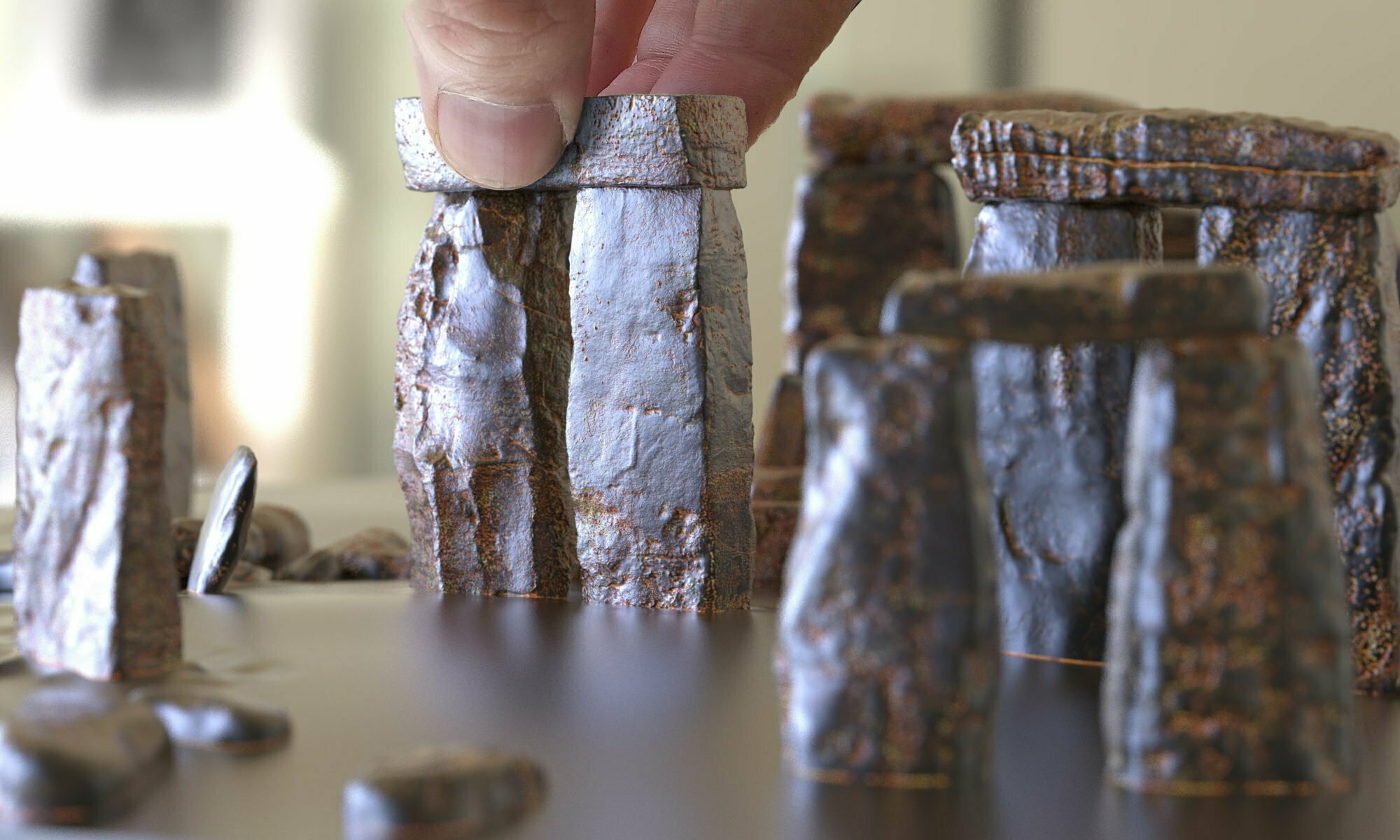
Stonehenge has an undeniable out of place feel, an OOPArt of inexplicable unusualness. Add in an impossible journey of heavy bluestones from West Wales; complex astronomical alignments; measurement units reused again and again across the world; and the sacred geometry of harmonious dimensions and shapes that define paradise. Overlay, the ancient highways of ley-lines, all interconnected from Stonehenge, across Britain, even into Europe and further into the world. All this, far beyond the capabilities of Neolithic people.
We are, as a species, deeply programmed to recreate Stonehenge out of such a variety of materials and objects, almost absent-mindedly. Certainly across all countries, times, civilisations. (My favourite are fish finger henges.)
Squint your eyes and see Stonehenge as a homage to the conventional image of a flying saucer — the ditch is the wing; the stone circle, with its lintels, windows; and the five trilithons the command centre. You just know that if you could find the switch, it would turn into a galactic portal to the far reaches of the universe.
There are floating orbs captured in photographs and video, reports of strange lights in the sky, lots of unexplained activity.
And this corner of Wiltshire has form. In the mid-1960s, the town of Warminster — a dozen miles west of the stones — became Britain’s UFO capital. “The Warminster Thing”: droning noises, lights in the sky, and nightly crowds of skywatchers gathered on Cradle Hill, all breathlessly chronicled by local journalist Arthur Shuttlewood. For a decade, the road past Stonehenge was the pilgrim route to Britain’s premier alien hotspot.
Then, on the afternoon of Sunday 7 July 1996, in the field directly opposite Stonehenge across the A303, the most celebrated crop circle of them all appeared: the Julia Set — 149 circles in a great fractal spiral, some 900 feet tip to tail. A pilot flew over at tea-time and saw nothing; three-quarters of an hour later it was there, in broad daylight, beside a busy trunk road, under the gaze of Stonehenge’s own security. Believers call it the best case for crop circles; sceptics have their answers. Either way: right field, right monument.
The only logical conclusion is… Paleocontact. Or a highly evolved human civilisation, like Atlantis, that itself gained knowledge from a race of giant space turtles.
Paleocontact was first proposed by Harold T. Wilkins in 1954; it took off in the 1960s mainly due to Erich von Däniken’s book Chariots of the Gods?, which has sold over 70 million copies. Not a fringe idea; a bestseller.
Calling occupants of interplanetary craft
We are your friends
The 1976 song, inspired by World Contact Day, a mass participation, telepathy event in 1953. To send a message to visitors from outer space. You may think that with all the UFO religions starting in the 1930s onwards, and there are so many of them, that aliens from outer space, in spaceships, can only be a modern idea. That flying saucers were entirely invented at the start of the Cold War. And you’d be wrong…
From India, the Rigveda, around 3,700 years ago (BC 1,700), are “mechanical birds jumping into space speedily with a craft using fire and water.”
Around 2,500 ya (BC 500), Indian Vimana, flying machines able to travel into space or underwater, and destroy entire cities using advanced weapons.
Around 2,400 ya (BC 400), the Hindu epic, Mahabharata, touches on time travel.
The 200 AD Greek novel A True Story had it all. First contact, interplanetary war, robots, even different laws of physics.