Celtic history
Celtic culture started around 3,200 years ago (BC 1,200) in central Europe and spread to Britain around 2,500 ya (BC 500), finally being conquered by the Romans from around 2,100 ya (BC 100) to the invasion of Britain in 43AD. Pushing Celts back into the unconquered Scotland and Ireland. Finally, their culture was displaced by the invasion of the pagan Angles and Saxons and the introduction of Christianity in the fifth century AD.
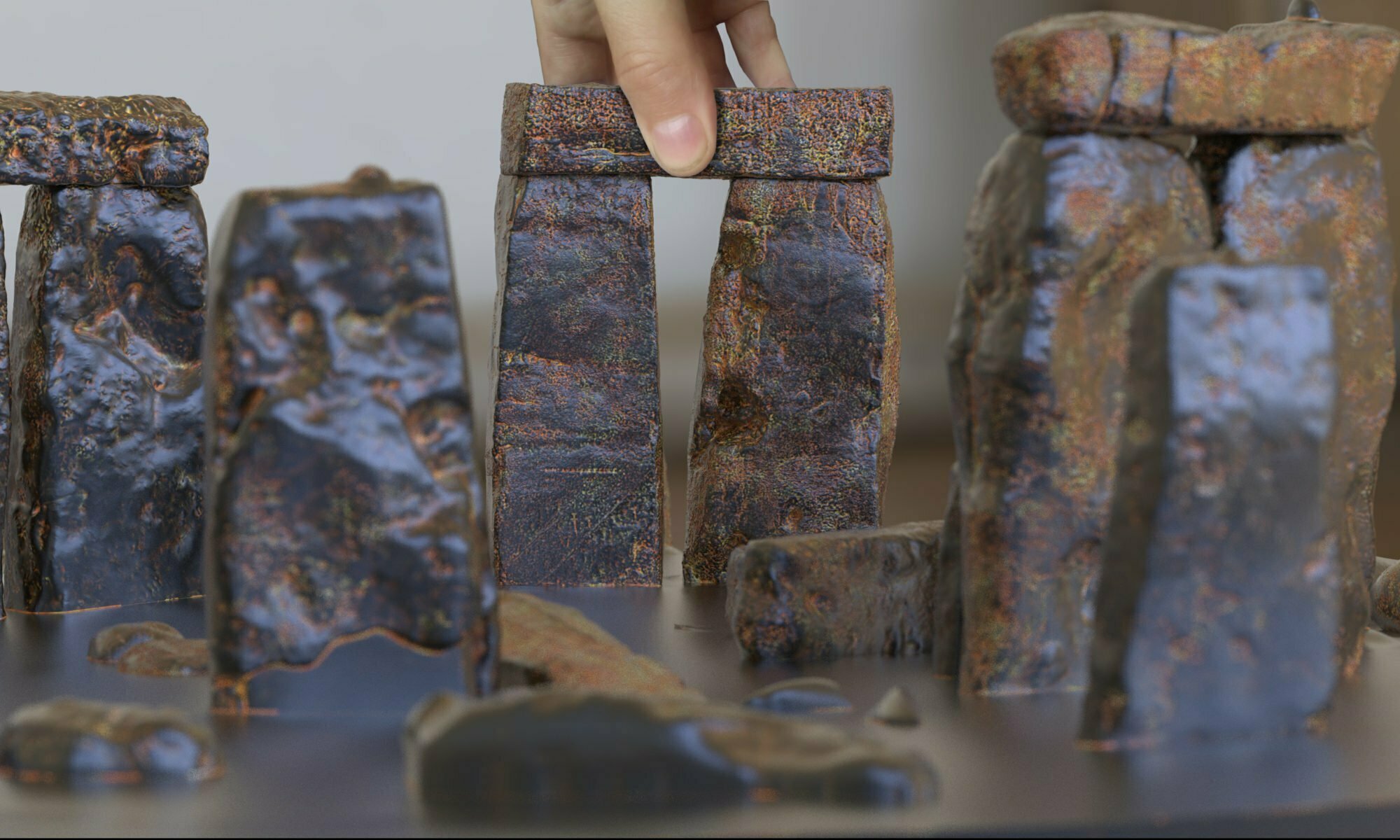
While druids may have practised here, at Stonehenge, there is little archaeological evidence. Indeed, as they’re thought to be more deeply connected to the earth, its natural spaces – springs and forests would be a more logical temple. Besides, Stonehenge began, perhaps 10,000 ya (BC 8,000), with wooden posts, in the old car park. 5,100 ya (BC 3,100) with the ditch. The last known structural activity was 3,600 ya (BC 1,600), around the same time as the Minoan volcanic eruption, all some 1,000 years before the Celts arrived in Britain.
Celtic druids
Druids were a high ranking class of Celts, second only to nobles. They had such power that if they stepped between two armies, they could stop the battle.
They were priests, judges, storytellers, doctors, political advisors, philosophers. Sacrificers, sorcerers, seers, oak-knowers, astrologers, naturalists. They were subdivided into bards: poets and singers, and Ovates: diviners and naturalists. Druids: moral philosophy.
The only records of them are from contemporary Greeks and Romans. The earliest reference was 2,350 ya (the 4th century BC). And the most detailed, by Julius Caesar around 2,050 ya (BC 50). That they would perform human sacrifices may well be imperialist Roman propaganda, though such stories also come from ancient Greek scholars.
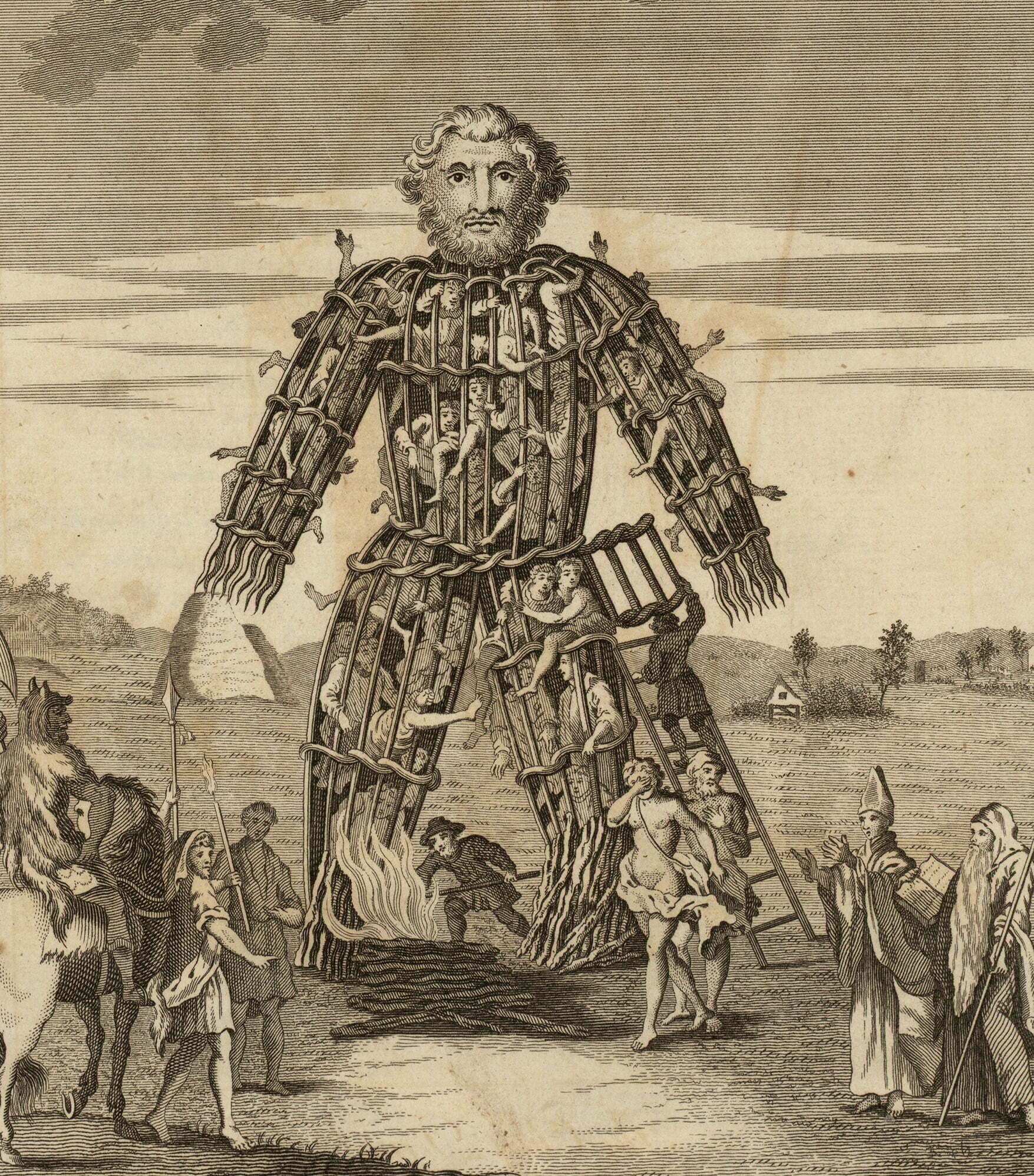
Sacrifices were through burning in a wicker man.
Their instruction was secret; hence no written records, and took place in caves and forests, and Caesar wrote that it took twenty years to instruct the Druidic laws. Foremost in these was the indoctrination of the immortality of the soul. Reincarnation robs death of all its terrors and can be the highest form of human courage.
Modern times
After disappearance
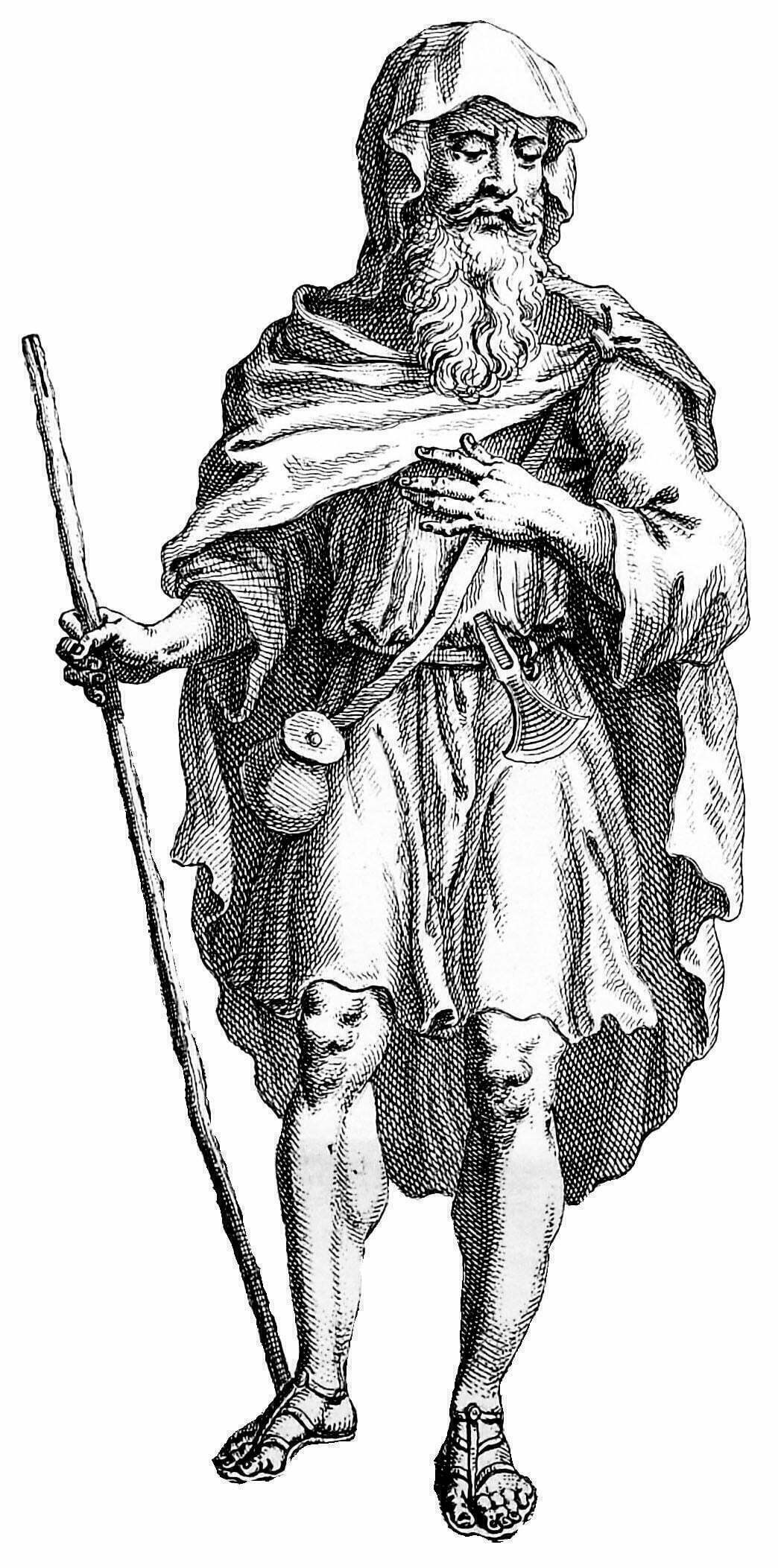
In the Middle Ages, after Christianity arrived, their reputation developed more into the magical realms and as prophets. Around 1500, German humanist Conrad Celtis had begun to propagate the image of the druids as having been bearded, wise old men, wearing white robes.
Druidry and Stonehenge, starts here
The seed was planted by the antiquary John Aubrey, who in the 1660s was the first to attribute the stone circles to the druids — the same Aubrey whose name the Aubrey Holes still carry. But the first wide audience for the connection of druids to Stonehenge and other megaliths was readers of William Stukeley’s book, Stonehenge, A Temple Restor’d to the British Druids, in 1740AD, and he proclaimed himself to be a “druid.” Soon after, several other people and groups self-described themselves as druids: in Anglesey in 1772, in Cardigan in 1779, short-lived and footnotes. But, in London, 1781, the Ancient Order of Druids formed and still remains the world’s oldest and regular Druidic order. Its motto is Justice, Philanthropy and Brotherly Love. It has little to do with Druidry, bar the iconography, being a fraternal organisation.
Now Stonehenge becomes a druid temple
Druidry had taken on an explicitly religious formation by the 1840s with Welshman Iolo Morganwg, holding services on Primrose Hill, London. William Price would become the most prominent of proponents of the Neo-Druidic movement toward the end of the 19th century and began holding ceremonies at Stonehenge.
The grand arrival came in August 1905, when the Ancient Order of Druids held a mass initiation at Stonehenge — 259 novices admitted in one go, processing between ranks of robed brethren, followed by a very large lunch at which, the local papers noted, a very large quantity of drink was consumed. The press mocked the cardboard sickles and false beards; the members — lawyers, doctors, clergy — mostly kept their hoods up. A young Winston Churchill was initiated into the Order three years later. Relations with the site’s owner were spikier: Sir Edmund Antrobus had fenced the stones and charged admission from 1901, and druids who refused to pay were, on occasion, escorted out by police.
Stonehenge and druid’s legitimacy
From this time onwards, many druid groups start, split off and change names — and the solstice grows wilder around them. From 1974 the anarchic Stonehenge Free Festival drew tens of thousands each June, until it was violently suppressed at the Battle of the Beanfield on 1 June 1985, when some 1,300 police “decommissioned” a travellers’ convoy seven miles from the stones. For the next fifteen summers a militarised exclusion zone sealed Stonehenge off at solstice — druids, pagans and public alike shut out, reduced to ceremonies at the perimeter fence. It took a 1999 House of Lords ruling to break the ban, and from the summer solstice of 2000 English Heritage has run “Managed Open Access”: free entry among the stones for the summer and winter solstices and both equinoxes. Tens of thousands now greet the midsummer sunrise inside the circle — druids front and centre, access lost and regained within living memory.
The campaigning didn’t stop at access. When archaeologists lifted cremated human remains from Aubrey Hole 7 in 2008, the druid King Arthur Pendragon — ex-biker, sword-carrier, serial litigant — fought a years-long campaign, including a High Court challenge, to have the ancestors reburied. He lost; the dead stayed with the scientists. But he made the news arguing it, in full regalia, which is a very druidic sort of victory.
And in 2010 came a quieter milestone: the Charity Commission recognised The Druid Network as a religious charity — the first pagan tradition in Britain to gain that status. Some 250 years after Stukeley declared himself a druid, druidry was, officially, a religion again. The early 1990s had been boom years for British Druidry; it and paganism have since spread throughout Europe.