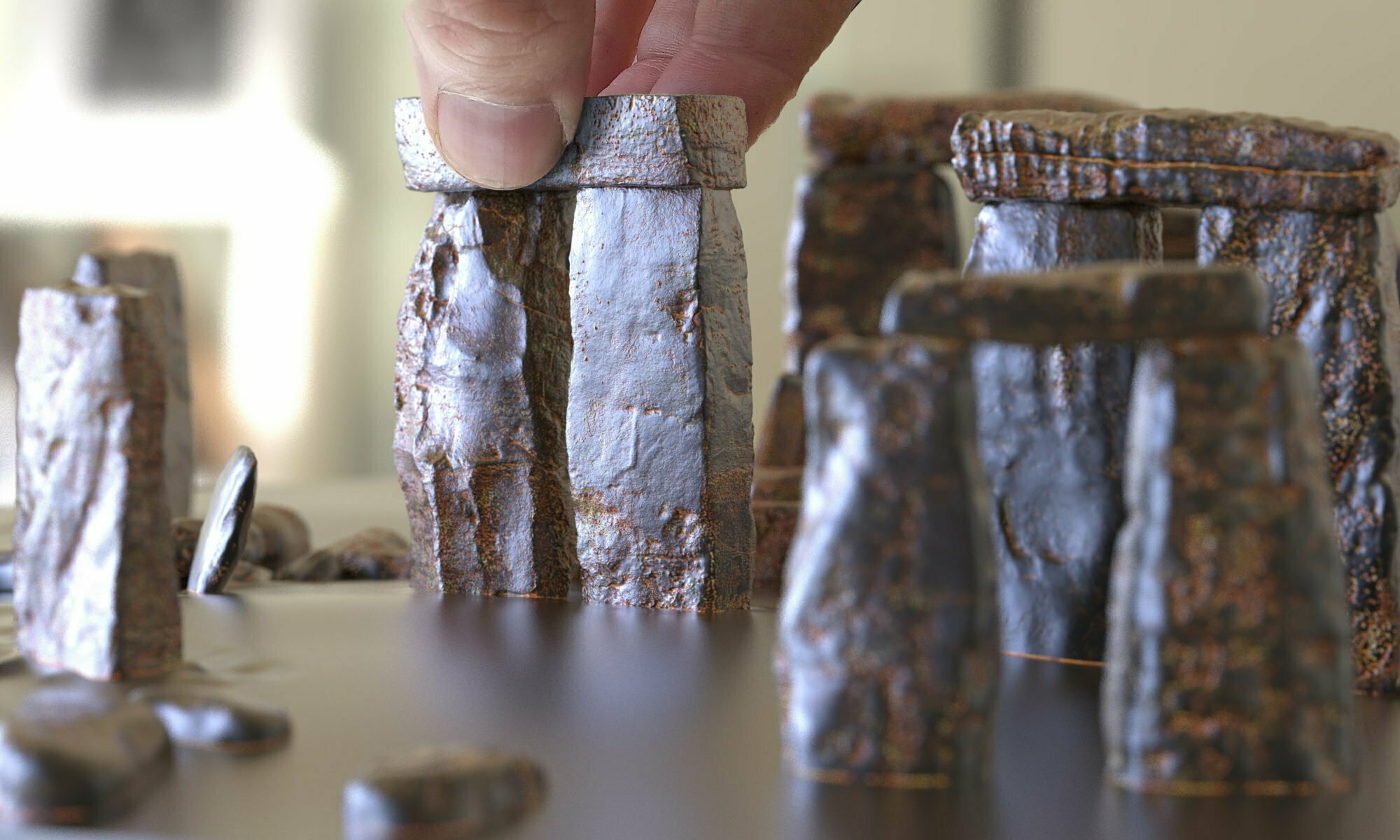
Whilst the other character pieces have whimsy, mythology and personality as an aid to scale, these plain versions rely on either a faint ruler or nothing — for the purists.
Scientific 3d scans
Lots of computational wizardry and muscle go to making these pictures. Lots of photographs are taken, stitched into a three-dimensional model, which is then rendered. It sounds like a short, three stepped process; it is anything but.
Ultimately, I created many versions of a view, in several materials, in a good deal of different lighting set-ups. For me, then, to layer them all, and select which parts are best to show which features. So, these are not views that would ever exist in real life.
There is precedent for looking at the stones this way. When English Heritage laser-scanned the whole monument in 2011-12, stripping the surfaces down to bare geometry revealed 71 previously unknown Bronze Age axe carvings — tripling the known total overnight, all invisible to the naked eye under weathering and lichen. And in 2025, researchers went a step further, digitally simulating and removing the lichen itself to recover carvings hidden beneath it.
What I do is more modest, and I would rather say so than have you assume otherwise. I take away the lichen’s colour, not the lichen. Where it grows thick, sea ivory above all, the plant stands proud of the rock and the scan records it as shape. Drain the colour and the shape stays. So: where the growth is thin, you are looking at the builders’ work. Where it is thick, you are looking at my best guess.
Art and craftsmanship
Plenty of artistic angst is also stirred into the pot. Plenty of times, I have torn my work into little bitty pieces and tossed it into the wastebasket, grumbling and muttering. Only now, that I am pleased with the results, am I allowing sales.
And pleased isn’t enough: proud, honoured. And thankful for the journey. For the knowledge gained about our heritage stones. Still mystified, obviously.
Don’t start me on the questions!
We know much more, these past fifty years, but still what could it have been here, at the very first? The Avenue, aligned with solstice. Was there anything atop? How are the pine posts of ~10,500 to 9,650 years ago connected? And what for those cursus?
A cremation cemetery, but was this the point, or a secondary use? Why can I barely squeeze through the trilithon gaps? Are the 115-plus axe and dagger carvings trial by combat or choices for sacrifice? Over 1,500 years of digging and shuffling stones around; why the changes?