Merlin: a jumbled myth
Popularised and stitched together in three books by Geoffrey of Monmouth around 1136. The stories of The History of the Kings of Britain were embellished and took on a life of their own by subsequent ‘historians’ and creative translators.
One part of his story, not the name, goes back beyond the Romans, into Irish Celtic times, where after going mad in a battle and fleeing into a forest, the character lived with the wild animals and received the gift of prophecy and magic. This was retold as being a Welsh and/or Scottish magician. Various names include: Myrddin Wyllt, Merlinus Ambrosius and Merlinus Celidonius. Geoffrey Latinized and, for his French readers, changed Myrddin to Merlin; it would have sounded too much like ‘merde.’ He also added that he was a bastard. Rather, born to a noble woman and an incubus, he was a cambion a half human, half demon.
Why here?
According to Geoffrey, sometime in the fifth century, there had been a massacre of hundreds of British earls and princes by the treacherous Saxon leader, Hengist. The Last of the Romans, Aurelius Ambrosius, having entirely routed the pagan enemies, restores all things in Britain, especially ecclesiastical affairs, to their ancient state. On his ‘fixing things tour’ around England, he comes to Kaercaradoc, the old name for Salisbury, 7.5 miles or 12km south of Stonehenge. The heroes were buried near a monastery on the mountain of Ambrius (now called Amesbury and 2.8 miles or 4.5km east of the stone circle). Moved to tears, he wanted to make the place memorable. Ultimately seeking out Merlin, the prophet of Vortigern, said to have invited Hengist and Horsa to aid him in fighting the Picts and the Scots. Merlin was a, “bright genius in predicting future events and in mechanical contrivances.”
Healing stones myth
Directly from Geoffrey’s history. “If you are desirous,” said Merlin, “to honour the burying-place of these men with an everlasting monument, send for the Giant’s Dance, which is in Killaraus, a mountain in Ireland. For there is a structure of stones there, which none of this age could raise, without a profound knowledge of the mechanical arts. They are stones of a vast magnitude and wonderful quality; and if they can be placed here, as they are there, round this spot of ground, they will stand for ever.” They are mystical stones, and of a medicinal virtue. The giants of old brought them from the farthest coast of Africa, and placed them in Ireland, while they inhabited that country. Their design in this was to make baths in them, when they should be taken with any illness. For their method was to wash the stones, and put their sick into the water, which infallibly cured them. With the like success they cured wounds also, adding only the application of some herbs. There is not a stone there which has not some healing virtue.”
Here is the twist: nearly nine centuries later, real archaeologists took Merlin at his word. In April 2008, Timothy Darvill and Geoffrey Wainwright led the first excavation inside the stone circle for 44 years, arguing that Stonehenge was a “prehistoric Lourdes” — a place of healing centred on the bluestones. Their evidence: burials around the monument show an unusual number of the sick and injured, many of them from far away; and the bluestones have been chipped and carried off for millennia — more than two-thirds of the original bluestone volume has vanished, plausibly as amulets. Merlin’s “not a stone there which has not some healing virtue” turns out to be a testable hypothesis. Not proven — but not laughed out of the room either.
Geoffrey’s tale is also, in effect, the first stone-transport theory: giant stones fetched from impossibly far away by extraordinary means. Modern claims keep the tradition alive — Wales for the bluestones; and in 2024 a study in Nature claimed the Altar Stone came from the far north-east of Scotland, a journey to make even Merlin blanch. (A 2021 claim that a dismantled Welsh circle was Stonehenge’s direct ancestor made headlines and then quietly fell apart under the follow-up geology.) Each retelling grows the distance; the arguments about how — and whether — people carried them continue. Perhaps the safest summary is still Geoffrey’s: none of this age could raise them without a profound knowledge of the mechanical arts.
The only logical answer is… Giants!
No giants — yet
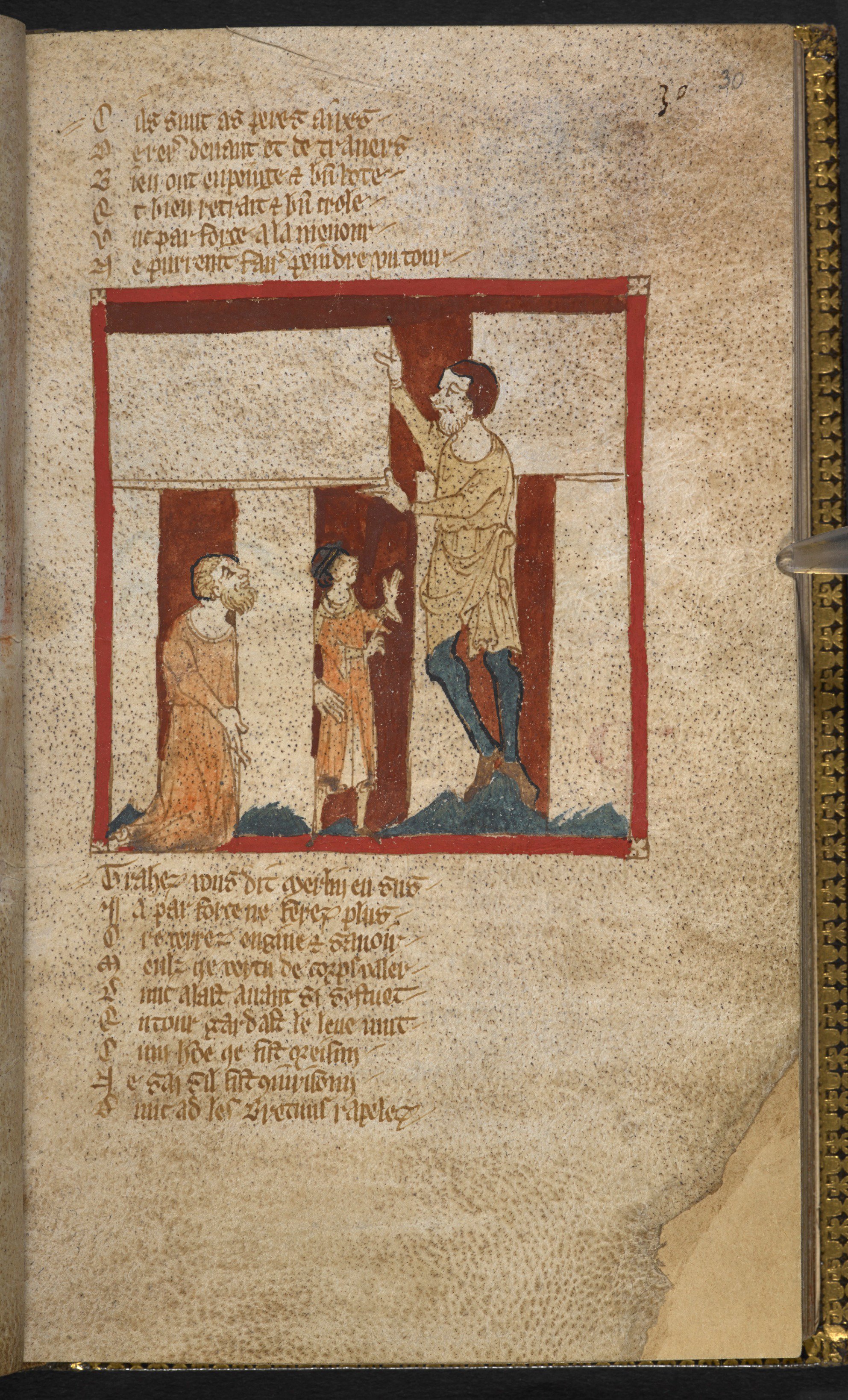
Whilst at Mount Killarus, Merlin laughed at the soldiers’ failed attempts to remove the stones using ladders, ropes, and other machinery. Shortly thereafter, Merlin oversaw the removal of stones using his own machinery and commanded they be loaded onto the soldiers’ ships and sailed back to England, where Aurelius ordered Merlin to set up the stones and Merlin “placed them in the same manner as they had been in the mountain Killaraus, and thereby gave a manifest proof of the prevalence of art above strength.”
Geoffrey’s story goes on to tell that Aurelius, his brother, Uther Pendragon, and Arthur’s successor, Constantine, were also buried at Stonehenge.
Now add giants
Roman de Brut, completed 1155, is a translation into French of Geoffrey’s and others’ history by a Jersey born cleric called, simply, Wace. Others added Robert. We only know of a 1325–1350 copy with the first illustration of Stonehenge that it wasn’t Merlin’s machinery, but giants that removed and rebuilt Stonehenge, under Merlin’s command. Wace also added the Round Table to the King Arthur story.
Very, very tall
Giants commonly feature in folklore and religious texts throughout Europe, Scandinavia, the Aztecs in Mexico, the early ages of Hinduism, and the very ancient Indian religion; Jainism, too, has a time of giants — six miles tall! As well, the Old Testament has its own giant. In Genesis, giants have been around since time began and are a mile tall.
With many very old and very large walls and buildings and even Roman statues, hill forts, stone circles, cromlechs, not least natural geological features like glacial erratics, raised beaches, the only logical and least complicated explanation was a lost race of giants.
The last of the giants
Geoffrey begins his history by explaining that there were but a few remaining giants in Albion before the Romans and that the expulsion of the giants, apparently throwbacks to an earlier age, seems to have been regarded as a necessary preliminary to the establishment of civilisation. He says Gogmagog, in stature twelve cubits — about 18 feet high, nearly as tall as our trilithons.