Long time dead
The history of ritual, difficult to study for sure, begins with burial and caring for the dead. Gifts are left for an afterlife. It may have started as far back as 300,000 years ago, or even further. The first known is 100,000 ya in a cave near Nazareth, Israel. After this, between 80,000 – 37,000 ya, both Neanderthal and Homo sapiens were burying their dead. Around 50,000 ya, there were probably shamans; just look at all the cave art from around then. Go deep into darkness, lit by torches, enter the trance and paint pictures of the dreams, as a hunter’s magic.
For us, in Britain, the Red Lady of Paviland, on the Gower, in Wales, dates back 33,000 ya. She is a he, a young man, with a periwinkle shell necklace, ivory rings all coloured with red ochre. (There would be a gap, as 22,000-14,000 ya Britain was an ice covered desert.)
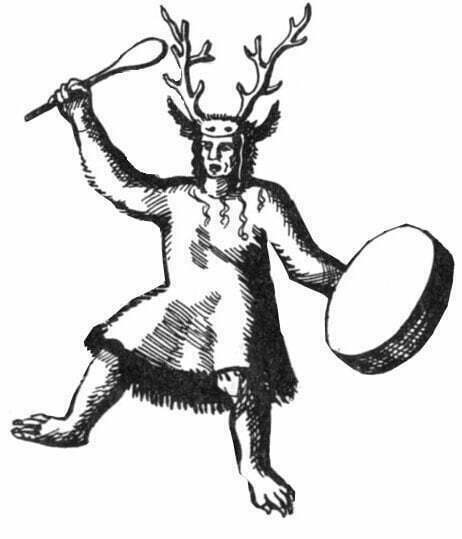
And then Britain hands us something extraordinary. At Star Carr in North Yorkshire, on the edge of a vanished lake, archaeologists have recovered more than 30 red deer antler headdresses — skull-caps with the antlers still attached, the bone perforated for straps — dating to 11,000 ya. That is around nine of every ten such objects known from all of early prehistoric Europe, in one Yorkshire field. Shaman’s costume, to become the deer and speak with the deer? Hunter’s disguise? The experts argue; the 17th century drawing of the antlered Tungus shaman on this page suggests where the smart money is. And these headdresses are near-contemporaries of the giant pine posts in Stonehenge’s old car park. The people who raised those posts lived in a world where antlered figures danced.
For us around Stonehenge, apart from the 10,000-year-old pine posts, which must have some ritual and Robin Hood’s Ball, which may date from 6,000 ya (BC 4,000), the earliest burial is the chambered tomb, West Kennet Long Barrow, 5,650 ya (BC 3,650). The Stonehenge Cursus around 5,630 ya (BC 3,630). The cremated remains from around the Aubrey Holes date to 5,000-4,500 ya (BC 3,000-2,500).
A mile east of Stonehenge, at a spring called Blick Mead, people gathered again and again from 10,000 ya to 6,000 ya — the longest-used Mesolithic site in the Stonehenge landscape. They feasted there on aurochs, wild cattle the size of small vans. And the spring has a trick: flints dropped into its warm water turn a vivid magenta-pink within weeks, stained by a rare alga. Imagine pulling a glowing pink stone from a steaming spring on a frosty Salisbury Plain morning. If that isn’t the birth of a sacred place, it will do until one comes along.
Shamanism
Putting dead people in holes in the ground, with gifts; painting bones with red ochre; creating elaborate tombs; burying cremated ashes; gathered from elsewhere; at some point, there would have been somebody who could also commune with these dead, in their afterlife. Someone who could use spirits for healing or guidance. Let’s use a modern word, shaman. Though to be clear, the oldest apparent sha-ladies burial was a shamanka in what is now the Czech Republic, around 27,000 ya.
To connect or travel to otherworlds, one needs an altered state of consciousness. Through madness, hallucinogenic mushrooms, lack of sleep, even a fever from disease, infection or head injury. Or an induced trance from sheer exhaustion through dance, music, or repetitive drumming.
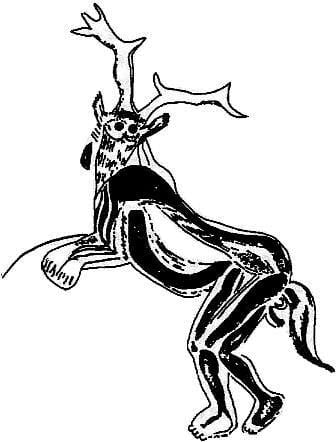
Shamans may dress with animal bones or skins, make animal noises and movements for a closer connection to spirit guides, to gain control of the prey, for good fortune in an upcoming hunt. Look at the Sorcerer cave sketch in France, 15,000 ya. Stonehenge’s old car park pine posts date to 10,000 ya, and the land bridge between Britain and France, Doggerland, finally disappeared around 8,000 ya.
They may go on vision quests for extended periods or scry or peep into fire, smoke, water, stones or many other media for purposes of prophecy.
All things
Animism
But, let’s not limit ourselves to just humans. All things—animals, plants, rocks, rivers, places, weather systems, human handiwork are animated, alive and possess spirits. The circle of Stonehenge’s ditch. Those queer bluestones. Sarsens, slipping down hills in sarsen trains. The spaces between trilithon uprights. And let’s go further into the magical beings that live in the cyclical growth of summer, becoming alive in spring, dying in autumn. The spirit of winter. Spirits in trees. Sacred groves.
Totemism
Bring it back to spirit guides, or guardians of a tribe, clan, family. Maybe the five central trilithons are five tribes, families, siblings. Spirits can protect the hunter or the gatherer. More individually, there is your own personal familiar.