Partisan. Say it up front. I think ice moved the big stones of Britain about and people stood them up, and I thought so before the geology got interesting. So read what follows as a man with a side and a map.
The occasion is a new paper on the Devil’s Arrows, the Millstone Grit monoliths beside the A1 at Boroughbridge, North Yorkshire. Put up something like 4,000 years ago (BC 2,000). The paper matches their zircons to Brimham Rocks, a crag 18 km west, and concludes that Bronze Age people picked that crag on purpose and dragged the stones eleven miles to a spot with no gritstone of its own. Deliberate sourcing. The word is in the title.

Ugg’s site meeting
Below the line, this bit. Ugg is the foreman.
“These rocks are special,” says Ugg. “We need three of them. Big ones. Twenty-five tonnes.”
“Right. Shall we put them up here, then?”
“No. We’re dragging the huge bloody things eleven miles over there.”
“Why?”
“Because over there is special.”
“But you said here was special.”
“Different special.”
A pause. Somebody at the back points out that the henges up the river at Thornborough are as far from over there as the crag is. Ugg has an answer for that too.
“C’mon fellas. Our ancestors done it before. Six tonnes of sandstone, all the way from the top of Scotland to Stonehenge. Seven hundred and fifty kilometres. This is eleven miles. Stop moaning.”
And there it is. The Altar Stone precedent, cited in the field, five hundred years after the event, by a man who has never seen a map. The paper does the same in its introduction with better spelling: the Arrows fit a pattern seen at Stonehenge, it says, where builders passed over nearer stone for stone from somewhere that mattered. The pattern being the one the same authors published. Ugg would call that job done.
The map
Above the line now. Everything in the picture at the top comes from the British Geological Survey, mostly the 1993 Harrogate memoir by Cooper and Burgess.
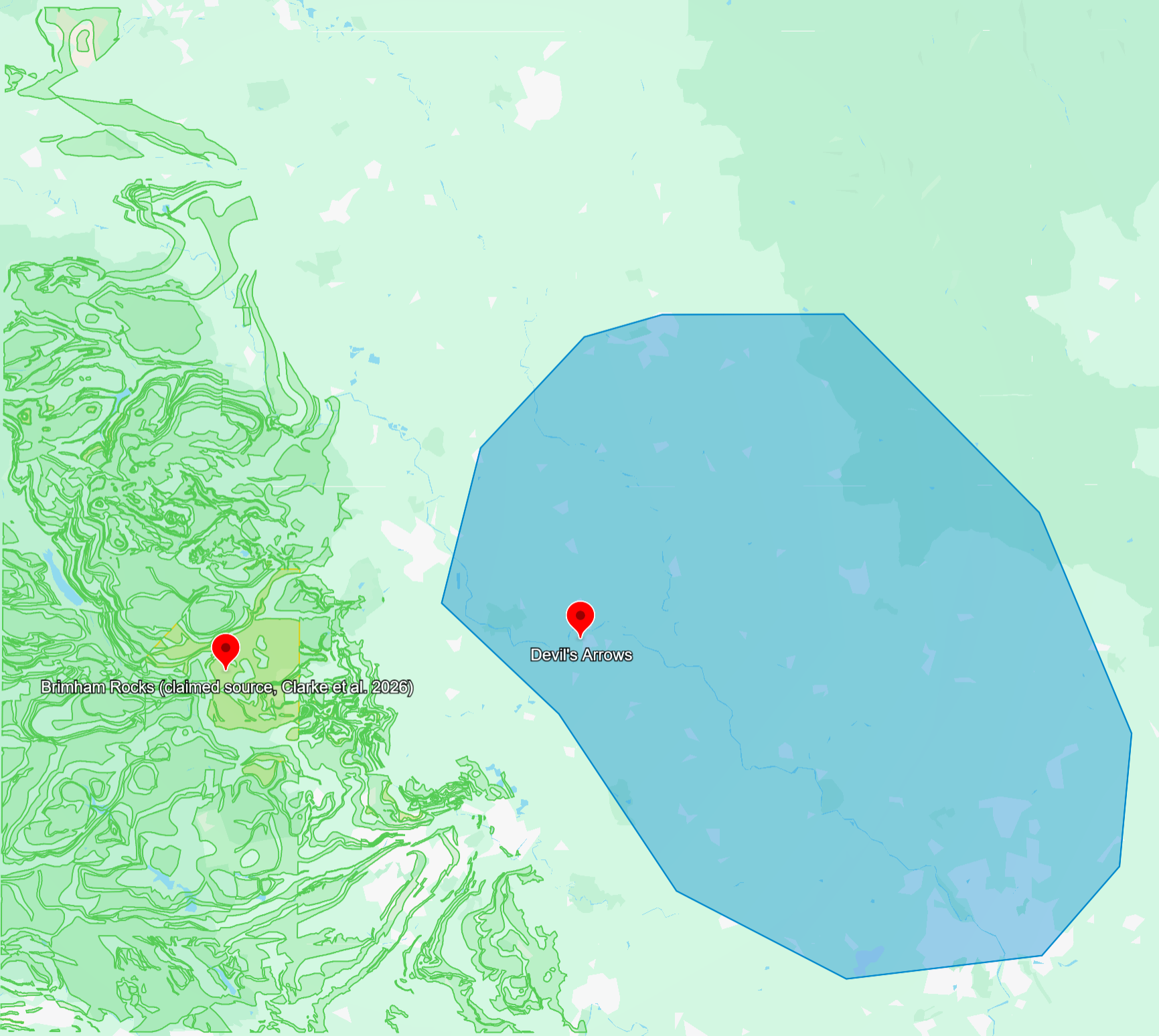
The blue shape is a lake. An old one: the Alne Glaciolacustrine Formation, laminated clay laid down in water dammed against the York moraine at the end of the last ice age, roughly 25,000 years ago. Its mapped limits run north to Thirsk, west to Littlethorpe and Hunsingore, east to Stockton on the Forest. Boroughbridge is inside them, which puts the Arrows at or near the western shore. Near, not on: my polygon is rough, and nobody has logged the ground under the stones themselves for this.
Under the lake clay is till, the ground-up mess a glacier leaves behind, and the memoir records it a kilometre from the stones: sand-blasted pebbles preserved beneath Devensian till at Aldborough. Under that is the Sherwood Sandstone the paper mentions. Bedrock, ice, lake, people, in that order, for the district. Whether the full sequence sits directly under the Arrows needs a hole nobody has dug for the purpose. The paper stops at bedrock.
What was in that ice? The memoir again: in the belt over the Sherwood Sandstone the till is full of subrounded pebbles and boulders of Carboniferous sandstone and limestone, Pennine rock, carried in from the north-west. The ice came down the Vale from the Lake District by way of Stainmore, with Dales glaciers feeding in along the western side. The Brimham Grit, the rock formation the crag is made of, crops out up-ice near Masham as well as at the tourist spot. The glacier had the whole formation to pick from on its way past.
Here is the same ground on the BGS Geology Viewer, three zooms, closest first. Hover on the viewer yourself and the yellow-green band under Brimham Rocks comes up as Unnamed Sandstone of Kinderscoutian Age, Millstone Grit Group. Pull back and the same Millstone Grits run north up the Dales edge, up-ice of Boroughbridge, in bands the paper never sampled. Whatever grit once lay between them and the Vale has been ground off and is now part of the drift.


Two ways to get tabular blocks of gritstone onto the shore of that lake without a rope. The unlikely one first: dropstones, blocks carried out onto the lake in floating ice and let go when it melted. Real things. Three of them, long and rectangular, from one formation, in one field: I would not put money on it. Unlikely rather than impossible.
The likely one: they were lying in the till before the lake filled, dropped by the ice that made the till, and when the water went they were long grey slabs in a river-crossing field, jointed like the ones still lying in the woods at Brimham today. Somebody stood them up. That story has no sighing in it.
What the memoir does not give me is a six-metre erratic. It records boulders up to 0.8 m in the quarry faces. Nobody has logged a megalith-sized block in the Vale of York till, and I am not going to pretend they have. Some may have been stood up or broken up, and a handful of gravel pits is not 25 km of buried till, but I cannot show either. The missing big blocks are a weakness in my story, and I would rather name it than have it named for me.
Erratics are amazing, then and now
Here is the part the papers never get to. A great slab of alien rock, sat in a field where nothing else looks like it, is a wonder. It was a wonder four thousand years ago and it is a wonder from the driver’s seat today. Brian John has written about the special status of unhewn rocks: stones that arrived by themselves, that nobody cut, that were already there when the first people walked up. You do not need to invent a magic quarry to explain why someone would stand one up. It was already magic. It fell out of the sky, or the sky’s cousin, ice.
I have driven past erratics hundreds of times on the A4059 from Brecon to Penderyn, scattered across the flank of Cadair Fawr, and I still slow down for them. I have gone through Llanberis Pass many, many times and always gawp at the roadside boulders that climbers now treat as furniture. If you live around south-west Birmingham, there are plenty in your suburbs too, with a project mapping them. And 45 miles west of the Devil’s Arrows, on the limestone above Austwick, are the Norber erratics, said to be one of the finest groups in Britain: dark gritstone blocks perched on pale limestone pedestals, each one on its own little plinth, put there by ice and nobody else. Go and look. Then come back and tell me Ugg needed a crag.
Anything but nature
I wrote about this habit last month: the reflex that reaches for ropes, rollers, cattle, boats, sledges, magic and cooperative Neolithic nations before it will look at a glacier that is, on the survey’s own map, standing on the site. The Arrows paper is the reflex in its purest form. Ice gets a sentence: the authors say glacial transport can be excluded. What they do not say is what they examined to exclude it. Whether that exclusion holds is the whole question, and the deposits that would test it are in the memoir, a kilometre from the stones, in the same county.
Leave the rocks to the geologists
I have A-level geology from a long time ago and a Google Earth file. The people who can take the mineral science apart have done so. Brian John on the Arrows paper: the formation is not the crag, one sampling spot cannot separate them, and the Devensian ice flowed the right way across the right rock. Peter Kokelaar, who has mapped Anglian erratics on Gower for real, on the whole bluestone and Altar Stone business: the best single account of the ice case I have read, and honest about what is known and what is guessed. Read them both.
Form
Clarke and Kirkland, the names on this paper, are the names on the 2024 Altar Stone paper and on the January 2026 river-sediment paper that says ice never reached Salisbury Plain. One habit runs through all of them: match the rock to a place, then never test the place against the wider ground it could have come from.
The Altar Stone was matched to the Orcadian Basin of north-east Scotland without testing sandstones of the same terrane in south-west Scotland, which is Peter Kokelaar’s whole point and the route the Irish Sea ice actually took. The Salisbury Plain sediment was sampled in four streams on the Plain rather than in the country to the west where ice would have dropped its load. The Arrows were matched to one crag from one sampling spot, with no comparison against the same formation where it crops out up-ice, or where it once cropped out and has since been ground off and buried under the drift. Each time the place is chosen first and the geology is asked to agree. Each time it does, because nobody asked it anything else.
So, no. I’m not buying it. Different special.
Be happy for ever.
Steve